For provosts and academic leadership
Every semester, an enrolled student decides whether to come back.
A student who leaves in year two takes four more semesters of tuition, fees, and housing with them, and that mid-degree seat rarely refills. Keeping the students already on your roster enrolled term after term is the highest-return retention work available — and now the follow-up is automatic: after two missed classes, the system nudges the student on its own, and over 92% come back.
Student 0147 · BIO 101
A pattern becomes visible.
Intervention queue
Years, not terms
A sophomore who leaves takes the remaining semesters of tuition, fees, and housing with them.
Seats rarely refill
Mid-degree vacancies depend on transfer yield, which is far less predictable than first-year admissions.
92%+ return
of students who receive the automatic two-absence nudge come back to class. AttendanceData sends it for you — nobody on your staff has to remember.
The economics of an empty seat
Attrition is not one lost semester. It is every semester that student would have paid for.
Leaves in year 1
Roughly six remaining semesters of tuition and campus revenue never arrive.
Leaves in year 2
Four remaining semesters lost, after the institution already absorbed recruitment cost.
Leaves in year 3
Two remaining semesters lost from a student who was already close to completion.
The backfill gap
Upper-level seats are filled by transfer, not by the admissions funnel. Most stay empty for the rest of that cohort's cycle.
Actual amounts depend on your net tuition, fees, and housing revenue. Use the calculator to put your own figures against your own attrition rate.
The honest version of "early alert"
The signal exists in week three. Most campuses do nothing until the student withdraws or the grades are final.
Midterm warnings in week eight are already late. Waiting for final grades is later still: by then the student has stopped attending, failed the term, and quietly not registered for the next one. The tuition is gone with them.
Why this has gone unsolved for decades
Campuses have not lacked concern. They have lacked attendance data at scale.
Attendance never left the clipboard
Paper sign-in sheets and roll call live with individual instructors. Nothing reaches advising, and nothing aggregates across a term.
Most campuses never intervene at all
In practice, contact happens after the student files a withdrawal or after final grades post. That is not an early alert. It is a record of a loss.
Coverage is optional, so it is partial
When capture takes classroom minutes, adoption stays low and the campus picture stays incomplete.
Capture across every course
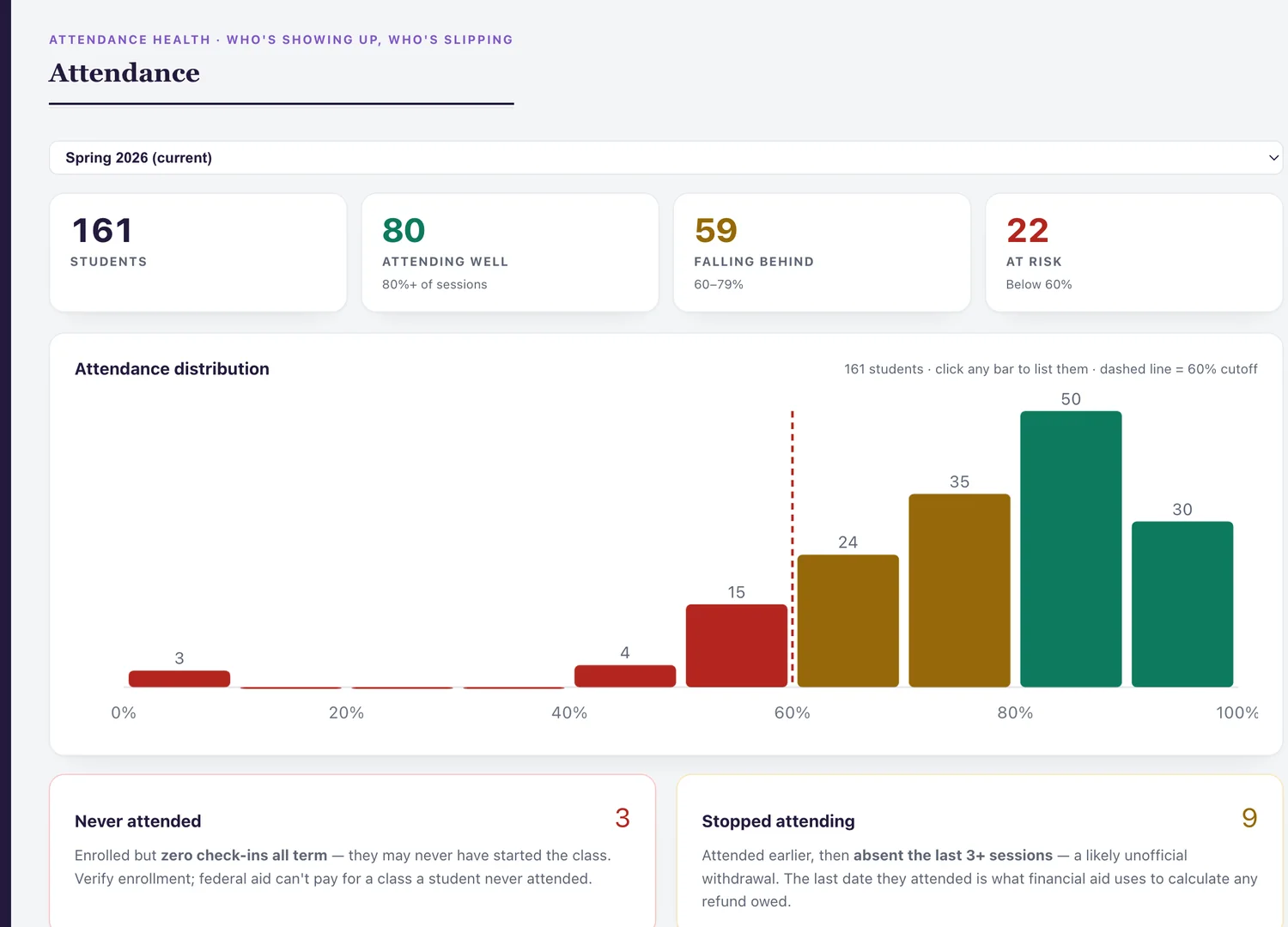
Attendance from every professor and every class, in one place.
- Students check in from their own phone by scanning a code or entering a PIN. No app, no account, no student cost.
- Instructors give up no lecture time and change nothing in the syllabus.
- After two missed classes, the system automatically nudges the student to return — no professor or advisor action required.
- Attendance becomes one shared record across courses, departments, and cohorts, with built-in outreach and an auditable send log.
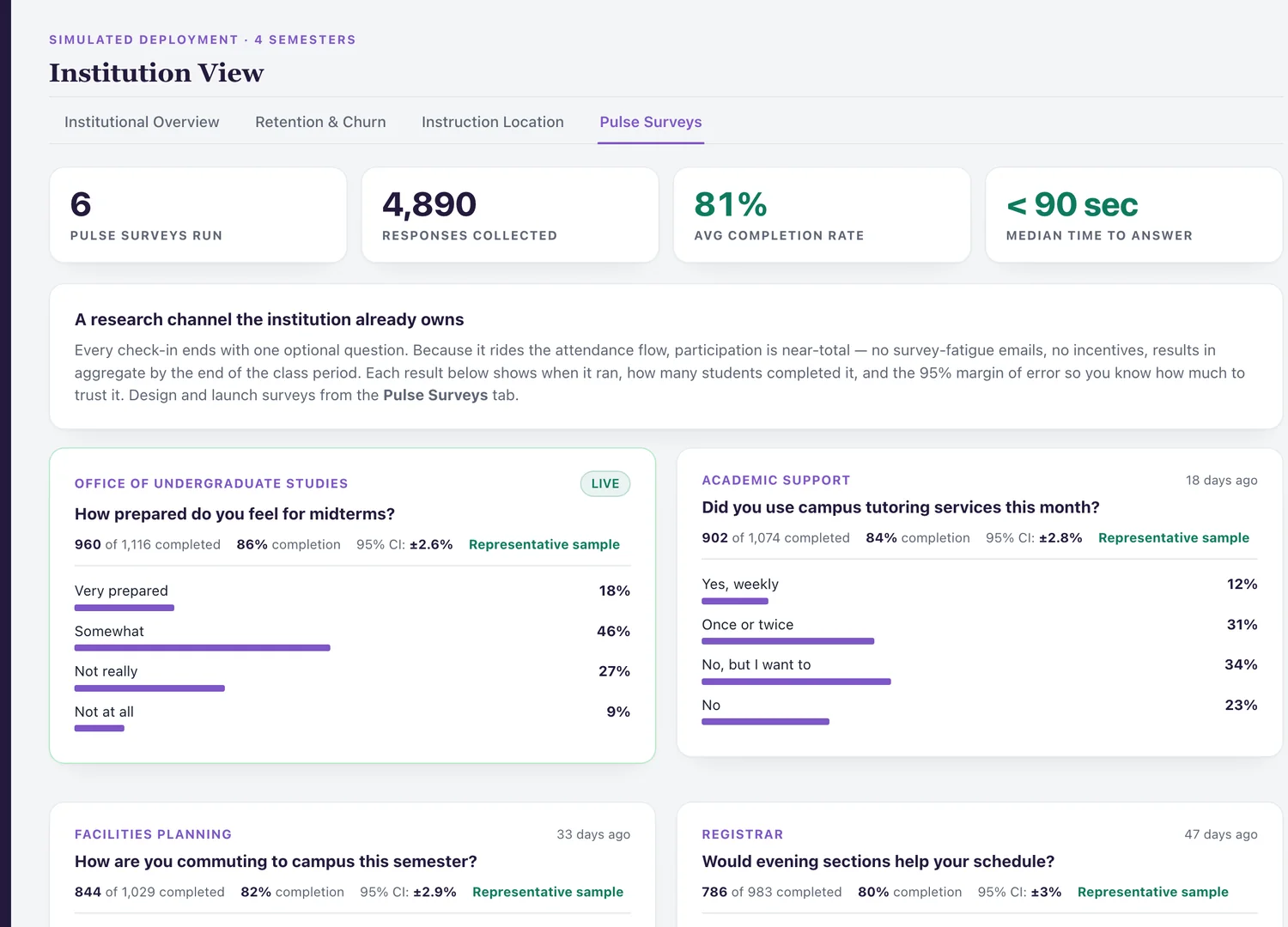
Campus pulse surveys
Ask once. Hear from students in the flow they already use.
One campus question can appear across participating check-in screens. Results include completion rate, a 95% margin of error, and an honest representative-or-indicative sample label.
Illustrative scenario · edit the assumptions
enrolled students
Estimated annual revenue protected
$1.94MScenario, not a forecast or measured result.Build the internal case
Put a number on the revenue you are currently unable to see.
Recovering even a small share of preventable departures each term protects multiple years of tuition per student. Model it with your enrollment, tuition, and attrition rate.
Model your institutionInstitutional control
Fit the system to your environment.
Review self-hosting, data flow, monitoring, roster intake, privacy controls, and production requirements with your technical team.
Review Security & TrustVerification under your policy
A one-time classroom-radius check and device correlation can support check-in verification. Either can be disabled institution-wide, and personal verification data can be erased on a schedule while the attendance fact remains.
Next step